Knitting Resistance: Part One by Beth Bartlett

“All the women knitted. . . . So much was closing around the women who sat knitting, knitting, that they their very selves were closing in around a structure yet unbuilt, where they were to sit knitting, knitting, counting dropping heads.”[i]  – A Tale of Two Cities 

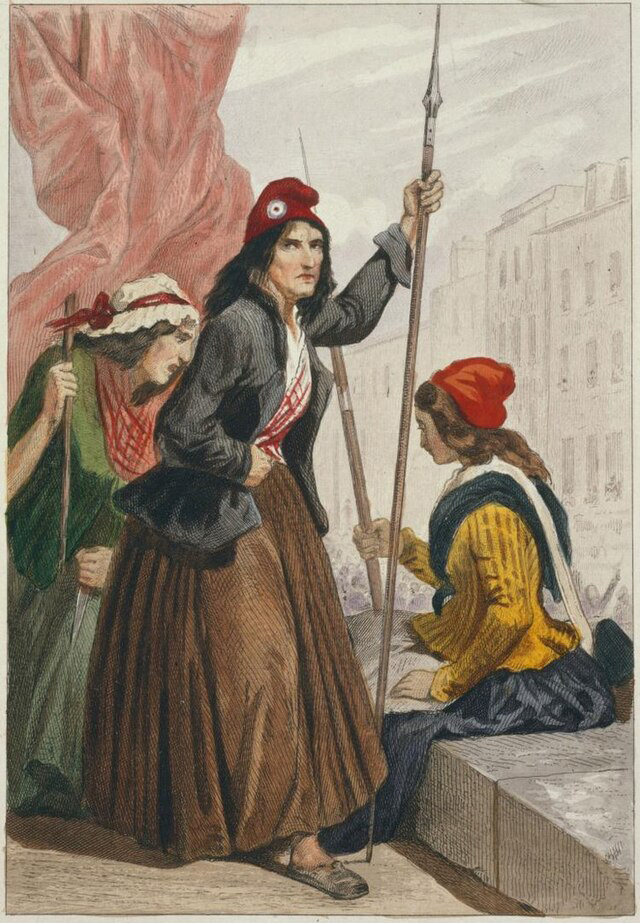
So does Charles Dickens tell the tale of perhaps the most infamous resistance knitter, the character of Madame DeFarge in his A Tale of Two Cities. Using a different pattern of knots for each letter of the alphabet, Madame DeFarge uses her knitting to encode the names of spies and traitors to be beheaded by guillotine in the French Revolution’s Reign of Terror. 
Tricoteuse

Her character is based on the true story of the tricoteuse – the women who notoriously knitted while sitting next to the guillotine. They undoubtedly took up this public position because just a few months before the Reign of Terror began they were banned from government proceedings and prohibited from forming any political assembly. Initially praised for their role in the resistance after successfully forcing Louis XVI to acquiesce to their demands following their march on the palace at Versailles protesting rising food prices, they had become too much of a threat to the aristocrats. It is said they were knitting liberty hats.

Fast forward to today.  Begun with a simple “Melt the Ice” pattern designed by Paul Neary from the yarn shop in Minneapolis, Needle & Skein, women and men all over the world are once again knitting liberty hats. The red pointed hats are modeled after the nisselue — or “Santa hat”– that Norwegian women knit as a symbol of resistance to the Nazis who were occupying Norway during WW II.  Needle & Skein made the pattern available for $5, with proceeds going to support rent and food assistance to those unable to leave their homes due to ICE’s ongoing presence in the Twin Cities.  As of March 5th, they had already raised $705,000. 

That the movement has become worldwide is extremely moving to those of us in Minnesota.  It lets us know we are not alone.  It has become a sisterhood of sorts, with a continual round of Facebook messages like this one from Elisabet Engström, “I am knitting the Melt the Ice hat right now. . . . It feels so good to be a part this. I live in Sweden.  Happy knitting to all of you.” Another writes from Ibaraki, Japan, that has a cultural exchange program with Minneapolis, that she is knitting MTI hats “in solidarity and support.”[ii] I particularly loved this one, “I changed the pattern a bit, but I’m loving the resistance and how much it’s already earned for donation. I’m 82 and can no longer march, but I can do this.”[iii]

These days, at every protest I attend and just walking around town, I see people, mostly women, wearing the red Melt the Ice hats. There’s something particularly fortifying about wearing one’s convictions so visibly in solidarity with others doing the same. On the 84th anniversary of the Naz’s banning the wearing of the nisselue hats, people all around the world wore the red MTI hats they had inspired, proudly displaying their resistance to the occupation forces of ICE that have terrorized cities and immigrant communities throughout the US. 

I first engaged in knitting resistance in 2009 when students in my course, “Women, Peace, and War” participated in CodePink’s Mother’s Day action against war, displaying a banner on the White House fence with the words, “We will not raise our children to kill another mother’s child.”  CodePink sent out requests for 4X4 knit squares in pink yarn, and so we began to knit.  Many of the students already knew how to knit.  We taught those who did not.  Most class sessions we were all busily knitting while discussing the readings on women’s roles in war and peace, and by the due date sent in a few dozen squares.  It was a wonderful exercise in activist engagement that also brought us together as a community in the classroom and with other anti-war feminist activists throughout the country.

Many people first engaged in knitting resistance when Kat Coyle of Ravelry – the social group for knitters and crocheters – created a pattern for the “pussy hat”[iv] – a symbol of resistance to Donald Trump worn in the first Women’s March following his inauguration in 2017.  The streets in Washington, DC and other cities across the country were filled with pink pussy hats.

Women’s March on Washington in 2017

These are just a few of the hundreds of ways knitting and other crafts have been used in resistance to oppression, tyranny, violence, and war.  In 2003, Betsy Good coined “craftivism” – a combination of “craft” and “activism” – to describe this worldwide movement.[v]  As one craftivist described it, craftivism is “a strategy for non-violent activism in the mode of do-it-yourself citizenship or do-it-together citizenship’.”[vi]  Craftivist and author Sarah Corbette wrote, “To be a craftivist is not just to be someone who likes craft: it is to be someone who hones their craft to question injustice, encourage peace and show ways to achieve a better world for everybody involved.”[vii]

Craftivism includes all forms of fiber and needle arts – from knitting and crocheting to embroidery and quilting and more – from the use of quilts encoded with messages about the underground railroad and its resurgence as a medium for resistance during the Civil Rights movement to the AIDS memorial quilt,[viii] from suffragists’ embroidered banners for votes for women to the embroidered arpilleras of women in Chile to document human rights abuses during Pinochet’s regime. But the craft that is currently engaging so many is knitting. Knitting has featured prominently in anti-war resistance, such as the aforementioned CodePink banner. During WWI and II, knitting was central to resistance workers who knit secret messages into scarves and mittens and sweaters, using knit and purl stitches to represent dots and dashes in Morse Code, or dropping stitches in strategic places to represent German train activity. Women knit themselves into webs during anti-nuclear protests at Greenham Common in the 1980s and decorated the perimeter fence around the air base with ribbons and knit items. The British “Cast Off Knitting Club” knit grenade purses to protest the Iraq War and in the US Starhawk and fellow protestors created a yarn web around the Pentagon.
The Tempestry Project

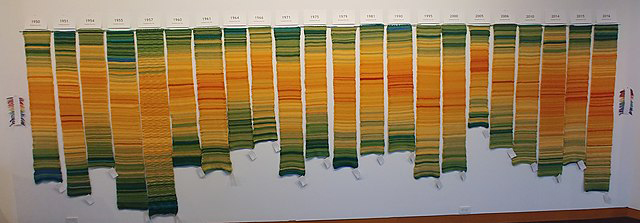
Knitting has been used as a form of protest for countless other causes as well. Suffragists in the US knit, sewed, and embroidered banners with declarations of women’s right to vote. The “Tempestry” project was begun in 2016 in response to concerns that the incoming Trump administration would minimize climate data. Participants knit ‘temperature scarves’ with specific color-coding to record climate change data in various places in the US.[ix] The “Liberty Crochet Mural” – consisting of 40 individual crocheted squares assembled into a 17ft x 11ft yarn mural — celebrates women’s reproductive autonomy and freedom to choose. In the “Welcome Blanket” project — a response to the first Trump administration’s proposed 2,000-mile wall along the United States–Mexico border, Los Angeles artist Jayne Zweiman and dozens of other fiber artists knit, sewed, crocheted, and wove 3,500,640 yards of blankets to welcome immigrants.[x]  And the Minnesota MTI hat is not the only anti-ICE knitting project. In Portland, Tracy Wright formed “Knitters Against Fascism,” which designed and promoted the Portland frog hat and conducts “knit-ins” outside the Portland ICE facility.[xi]
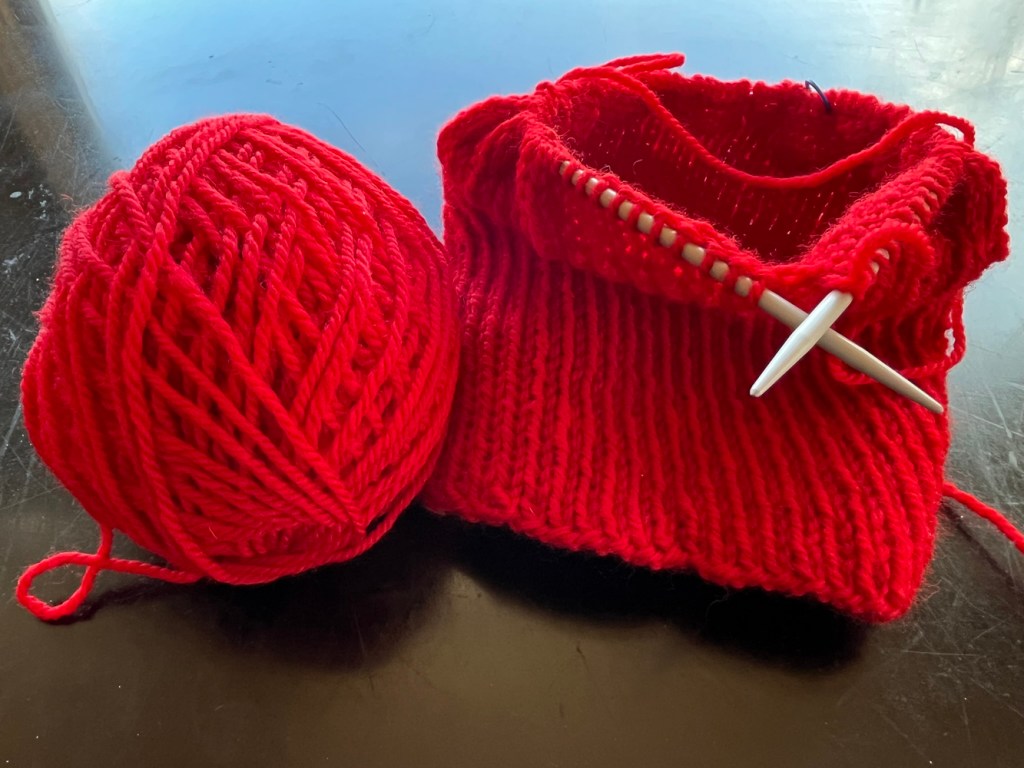
MTI hat in production

In Part II, more on knitting resistance and feminism, gentle protest, and community building – tomorrow

References

CODEPINK. Collecting Knitted Squares For Mother’s Day. – craftivism.

Corbette, Sarah P. How to Be a Craftivist: The art of gentle protest.  Unbound. 2018.

Craftivism: Empowerment, Resistance, and Activism Through History – The Morning Crafter

craftivism. – craft + activism = craftivism.

Craftivist Collective

Crafty Wartime Spies Put Codes Right Into Their Knitting | HowStuffWorks

Dickens, Charles.  A Tale of Two Cities. The Works of Charles Dickens. Vol XIII. New York: Peter Fenelon Collier, Publishers. 1910.

Engström, Elisabet, Ravelry Facebook post. 2/20/26.

Full Service Yarn Shop in St. Louis Park, MN | Needle & Skein

Greer, Betsy, ed. Craftivism: The Art of Craft and Activism.  Vancouver: Arsenal Pulp Press, 2014.

Henderson, P.L. Unravelling Women’s Art: Creators, Rebels & Innovators in Textile Arts. Richmond, UK: Supernova Books, 2021.

How Knitting Enthusiasts Are Using Their Craft to Visualize Climate Change

Knitting, Codes, and Espionage Through the Ages – Tim O’Neill Studio

Knitting as Resistance – Reformed Journal

Laware, Margaret L. “Circling the Missiles and Staining Them Red: Feminist Rhetorical Invention and Strategies of Resistance at the Women’s Peace Camp at Greenham Common.”  NWSA Journal, Vol. 16, No. 3 (Autumn, 2004), pp. 18-41.

Liberty Crochet Mural

Literary Hub » On the Covert Role of Knitting During the French Revolution and World War II

Mikki, Ellen Rettig. Ravelry Facebook post.  3/2/25.

Moreshead, Abigail & Anastasia Salter. “Knitting the in_visible: data-driven craftivism as feminist resistance,” Journal of Gender Studies (2023) 32:8, 875-886, DOI: 10.1080/09589236.2023.2258068.

O’Neill, E. (2022). Knitting: The Destructive Yarn-Bomb. TEXTILE, 1–10. https://doi.org/10.1080/14759756.2022.2138062

Steele, Bonnie Leigh. Ravelry Facebook post. 2/24/26.

Stitching Resistance: How Women Used Fiber Arts to Make Political Statements and Spark Rebellion | by Nikki Wheeler | Medium.

The Politics of the Handmade. How fiber arts are powering modern… | by Amanda Varley | Feb, 2026 | MediumCraftivism: The History of Arts as Social & Political Dissent – Thread and Maple.

‘Weapons of mass construction’: the US ‘craftivists’ using yarn to fight back against Trump | Art | The Guardian

Welcome Blanket

* Photo Credits: 2017 Women’s March: Creative Commons;  Tempestry Project: Creative Commons; Les Tricoteuse: Public Domain.


[i] Dickens, 200, 201, & 207.

[ii] Rettig.

[iii] Steele.

[iv] The “pussy hat” was inspired as a protest against Trump’s infamous statement in a 2005 tape, “When you’re a star, they let you do it. Grab them by the pussy. You can do anything.”

[v] The term “craftivism” is usually attributed to Betsy Greer, but she actually coined the term when after she mentioned a connection between craft and activism, “Buzz,” one of the women in her knitting circle, said, “You could call it craftivism.” Greer then posted it on her online journal in 2000, and in 2003 bought domain named craftivism.com, which has become a worldwide network of craftivists.

[vi] “Deb” in Vachhani, 533.

[vii][vii] Corbett, 304.

[viii] Evidence suggests that quilt patterns such as the “Log Cabin” or “Flying Geese” may have been used in the Underground Railroad to provide coded messages to guide enslaved people to freedom. Women in the Civil Rights movement organized quilting circles as a form of resistance. The quilts made during the Civil Rights movement were often sold to raise funds for the movement. The AIDS memorial quilt originated in San Francisco in 1985 to memorialize those lost to AIDS. Gert McMullin, the ‘mother’ of the quilt, sewed the first stitch and since then 50,000 panels have been added, honoring more than 110,000 individuals. Weighing 54, it is thought to be the largest community art project ever created. It has raised more than $3 million dollars for AIDS services. Other famous resistance quilts include The Border Wall Quilt Project, a collection of 8” x 16” quilt pieces expressing concern about the border wall and the Broken Treaty quilts, created by Gina Adams, with texts taken from treaties to demonstrate the broken promises and injustices to indigenous peoples.

[ix] The Tempestry Project is ongoing.  To learn more or participate, see Tempestry Project – Your access to climate change data in a wearable and comfortable fashion, preserved for years to come..

[x] The project quickly exceeded its goal and aims to encircle the globe in 36,521 handmade pieces. 8,000 have been collected so far. To learn more or participate, see Welcome Blanket.

[xi] The proceeds from the sale of the pattern have raised $500 for local food shelves.
The pre-Christian Roots of Purity Culture by Victoria Alvear

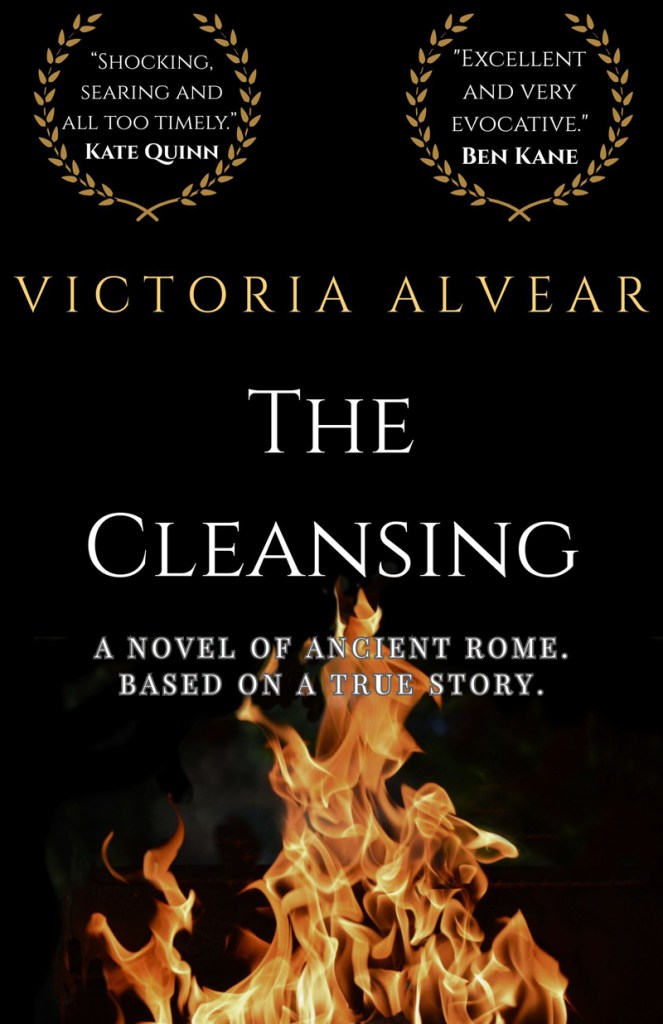
Published by Hypatia Press, The Cleansing deconstructs the roots of religious-based misogyny and purity culture through the real story of a Vestal Virgin accused of breaking her vow of chastity. Midwest Book Review called the novel, “Original, exceptional, deftly crafted and a simply riveting read from cover to cover.”

Writing a novel about the persecution of a Vestal Virgin priestess in ancient Rome really brought home for me just how deep the religious roots of misogyny and purity culture go. In my novel, The Cleansing I focused on the true story of a Vestal accused of having sex and being blamed for the massacre of 50,000 men in one battle.

 Two hundred years before Christianity, Rome’s religious leaders claimed only a “crime” of that magnitude—of one of their sacred virgins breaking their vows—could have “disgusted” the gods enough to cause them to turn their backs on Rome. The Vestal faced a death sentence—being buried alive—for this so-called “crime.”

Meanwhile, the general who made a massive strategic error in battle, the man responsible for marching tens of thousands of soldiers into a trap, walked away scot-free.

It seemed unbelievable to me that they truly believed a woman’s sexual conduct could have that much influence and power. And yet they did, as evidenced by the fact that the Romans buried alive two dozen Vestal Virgin priestesses (that we know of) during Rome’s existence. When a tragedy occurred—war, famine, pestilence—the head priest of Rome, the pontifex Maximus, and the Collegium of priests often claimed that one or more of their six Vestal priestesses “had” to have had sex to explain away the tragedy.

Continue reading “The pre-Christian Roots of Purity Culture by Victoria Alvear”

The Circle as a Field of Human Integration by Paul Robear

This blogpost is included as part of FAR’s co-operation with other organizations to highlight and amplify each other’s voices. Paul Robear is President and Executive Director of The Cuyamungue Institute (CUYA).
CUYA is the international home of Ritual Postures and a global leader in transformative experiences rooted in ancient traditions — offering workshops, research, and online learning that open pathways to expanded states of consciousness.
CUYA, The Felicitas D. Goodman Institute is an independent, 501c3 not-for-profit educational organization committed to the study of “ASC” Altered States of Consciousness as a natural extension of the human experience.  

Finding Coherence in Shared Presence

Why have human beings always gathered in circles?

I have often wondered why I am instinctively drawn to them; my body seems to recognize a quiet stability before my mind can explain it.

The circle itself generates a kind of collective coherence.

Long before there were formal doctrines or institutions, there were fires, drums, breath, and bodies moving together in a circle. Across cultures and continents, people entered rhythm — through chant, movement, and synchronized breath. While these practices were often interpreted through religious frameworks, something more fundamental was occurring beneath the symbolism.

In a circle, every face can be seen, every movement sensed. Nothing approaches from behind. The body registers this orientation as safety.

Ritual, then, may be one of humanity’s oldest technologies for collective coherence.

Continue reading “The Circle as a Field of Human Integration by Paul Robear”

Annual Report 2026: From Protests, to Uprising, and the Role of Iranian Women

On the eve of International Women’s Day 2026, the NCRI Women’s Committee presents its Annual Report 2026, offering a recap of events in 2025 as related to women’s rights in Iran.

Moderator’s Note: This post has been brought to you in cooperation with the NCRI women’s committee. NCRI stands for the National Council of Resistance of Iran. You can learn more information as well as see this original article by clicking by link below. A description of their Council can be found at the end of this post. As an introduction, a NCRI representative sent us the following statement about the war.

 STATEMENT: I would like to mention that the Iranian Resistance — which established a government-in-exile years ago — has long advocated a clear position: no to war, no to appeasement of the mullahs, but a third option — regime change by the Iranian people and their organized resistance.

Mrs. Maryam Rajavi, the President-elect of the Resistance and an internationally recognized figure, has outlined this vision in her Ten-Point Plan. I am sharing the link below, as it reflects the roadmap of the Iranian Resistance. Maryam Rajavi’s Ten-Point Plan for the future of Iran

Unfortunately, behind-the-scenes dealings and political interests have often ignored this democratic alternative. In recent days, a provisional government framework has also been announced as part of this process. Announcement of the Provisional Government by the National Council of Resistance of Iran (NCRI)

In any case, we are prepared to determine the future of our own country. We kindly ask you to help reflect the voice of the Iranian Resistance, a movement notably led by women ,so that this alternative can be more widely heard.

AND NOW FOR THE ANNUAL REPORT

Continue reading “Annual Report 2026: From Protests, to Uprising, and the Role of Iranian Women”

Reflections in a Winter Forest by Sara Wright

Shimmering Seep

Yesterday’s welcome sun and warm temperatures had me out the door to lay down another round of ashes before the next storm. After packing down our woodland paths with snowshoes we were off to our favorite forest. I had planned to look for liverworts but as usual nature had other plans nudging me to note which trees might be photosynthesizing  around these forest edges. At any given moment there are thousands of interactions between tree bark and ki’s environment that most of us take for granted. If you pay attention to bark you may, like me, develop a deep respect for the unparalleled beauty and for the protective skin of every tree. Especially during the winter months.

We know that bark protects the tree from insects and other damage, and the thick ridged bark of older pines or hemlocks also holds moisture in ki’s fissures as well as providing creaturely homes.

I feel compelled to stop to run my hands over these thick white pine trunks in gratitude and awe for their existence. I do the same thing at home in my modest sanctuary, but here the pines are older like the ones that once entirely covered the mountain behind me, all the way to the ledges…I remind myself that the waxy needles on conifers also photosynthesize on warm sunny days.

Continue reading “Reflections in a Winter Forest by Sara Wright”

The Legacy of Carol P. Christ: Troubling Our Souls: Selling Arms to Saudi Arabia, the War in Yemen, and the US Military Industrial Complex

This was originally posted 10/22/18

There is a very big elephant in the room. Apparently it is invisible because even the left is not discussing it. This elephant is the civil war in Yemen to which Saudi Arabia has contributed 19,000 (19,000!) deadly (deadly!) air strikes that have been alleged to have caused 60,000 (60,000!) civilian (civilian!) deaths (deaths!). These air strikes have been carried out with arms purchased from the US and its allies. The UN estimates that 22.2 million Yemeni civilians are in need of immediate humanitarian aid and that 13 million are at the risk of starvation. Yet a Saudi-led blockade is preventing food and other supplies from entering the country.

In the wake of the disappearance of legal American resident and Saudi journalist Jamal Khashoggi, the left castigates Saudi Arabia for a vicious murder. The US President warns congress not to cut off arms deals with Saudia Arabia because to do so would threaten more than half a million US jobs in the military industrial complex.

Continue reading “The Legacy of Carol P. Christ: Troubling Our Souls: Selling Arms to Saudi Arabia, the War in Yemen, and the US Military Industrial Complex”

From the Archives: “On Purim and the Value of Courage.”

Author’s Note: This post was first published on 10 March 2013. This year, Purim was on the 2nd of March. This post has updated imagery.

The Jewish Festival of Purim and the book of Esther offer us an opportunity to reflect on the value of courage from a feminist perspective. The online Webster’s Dictionary defines courage as, “mental or moral strength to venture, persevere, and withstand danger, fear, or difficulty.” In religious discourse, courage is often categorized as a virtue or a moral principle. Aristotle (384BCE – 322BCE), one of the most famous of the virtue ethicists, believed a virtue like courage should be practiced according to the mean or the right amount. Too much courage leaves one rash, possibly too reactionary and hot-headed while too little makes one cowardly and weak, but just the right amount in a given situation leads to moral behavior. Virtuous living leads to happiness, or perhaps is itself happiness, for Aristotle.  Yet, as a feminist, I understand the worth of courage differently.  To me, the value of courage lies not in individualistic gains nor in personal happiness but in its use toward achieving justice and equality in society.

Continue reading “From the Archives: “On Purim and the Value of Courage.””

From the Archives: I Believe Anita! by Marie Cartier

Moderator’s Note: This has been posted on FAR twice, originally on April 7th, 2014 and then again on July 15, 2022. We are posting this a third time because of its importance. It is a piece of history that helps to illustrate how we got to where we finds ourselves today.

Marie Cartier

During the past week I attended a Los Angeles premiere of a new documentary Anita: Speaking Truth to Power (Dir: Freida Lee Mock USA, 2013). The screening was sold out and I had great seats saved for me– sitting with a friend who works at Samuel Goldwyn, the distributor of this fine film.

In 1991, Anita Hill provided testimony she hoped would serve to dissemble the nomination of Clarence Thomas as a Supreme Court justice. Although the vote would end up being close (52-48) Hill’s testimony did not serve to dissuade the decision — Clarence Thomas’ nomination was confirmed and he was appointed to a life term on the Supreme Court four days after Hill’s testimony concluded. Here is an outline of the debate.

Continue reading “From the Archives: I Believe Anita! by Marie Cartier”

Visibility Matters: Where are the Women? by Maria Dintino

Moderator’s Note: This piece is in co-operation with The Nasty Women Writers Project, a site dedicated to highlighting and amplifying the voices and visions of powerful women. The site was founded by sisters Theresa and Maria Dintino. To quote Theresa, “by doing this work we are expanding our own writer’s web for nourishment and support.” This was originally posted on their site on March 4, 2025. You can see more of their posts here. 

Visibility Matters: Where are the Women?

Out of forty monuments along the National Mall in Washington, DC, none celebrate women and their contribution to American history.

One of our NWW [Nasty Women Writers] categories is Breaking the Bronze Ceiling where we track the effort to increase the number of monuments dedicated to real women in public spaces.

I’ve made many trips to Washington, DC, trekking the National Mall specifically to visit monuments. Why didn’t I notice women were missing?  Am I so conditioned to not seeing women recognized and honored at the highest levels that I don’t even expect it or question their absence?

I felt ignorant and complicit.

It’s 2025 and there is not a single monument to honor women on our National Mall, a place that “draws roughly 36 million visitors a year, more than Yosemite, Yellowstone and the Grand Canyon combined”(Schuessler).

It’s absurd and sadly, speaks volumes.

Continue reading “Visibility Matters: Where are the Women? by Maria Dintino”

The Epstein Files Prove Just How Right Carol Christ Had Been, part 2 by Janet Maika’i Rudolph

Part 1 was posted March 1st. You can read it here. The definition that Carol refers to as well as a link to her original article can be found there as well. Her words are in italics.

It has long seemed to me that patriarchy cannot be separated from war and the kings who take power in the wake of war.  Many years ago I was stunned by Merlin Stone’s allegation that in matrilineal societies there are no illegitimate children, because all children have mothers. Lately, I have been trying to figure out why the Roman Catholic and other churches and the American Republican party are so strongly opposed to women’s right to control our own bodies and are trying to prevent access to birth control and abortion. In the above definition of patriarchy  . . . I bring all of these lines of thought together in a definition which describes the origins of patriarchy and the interconnections between patriarchy, the control of female sexuality, private property, violence, war, conquest, rape in war, and slavery. 

From the Facebook page of GirlGodBooks

Here Carol lays it all out. I, too, have wondered why the Church, why conservative politicians are so obsessed with women’s bodies and reproductive systems. No wonder abortion, in fact all of the healthcare of women is so on the political radar. Taking away the agency of women when they become pregnant is dehumanizing, reduces women to incubators. And that doesn’t even go into the fear of treating women for any health issues when they are pregnant. Take the tragic case of Tierra Walker who died in Texas, pregnant and facing growing health problems. She had a 14year old son and after weeks of severe distress attempted to get an abortion. She was unable to do due to the strict anti-abortion laws in Texas as she went to doctor after doctor. Here is what they told her: “But the doctor, her family said, told her what many other medical providers would say in the weeks that followed: There was no emergency; nothing was wrong with her pregnancy, only her health.” Its as if there was a cabal to diminish the value of women’s lives that even the doctors, who know better, participate in. And that is the templated of patriarchy. True that the doctors are threatened with loss of license and 10 years imprisonment begin. But when they spout the “party” line, they not only risk their patients, they deepen the already ingrained belief that women and our bodies are without worth.

Continue reading “The Epstein Files Prove Just How Right Carol Christ Had Been, part 2 by Janet Maika’i Rudolph”